


How to Identify Antique and Vintage Lamps

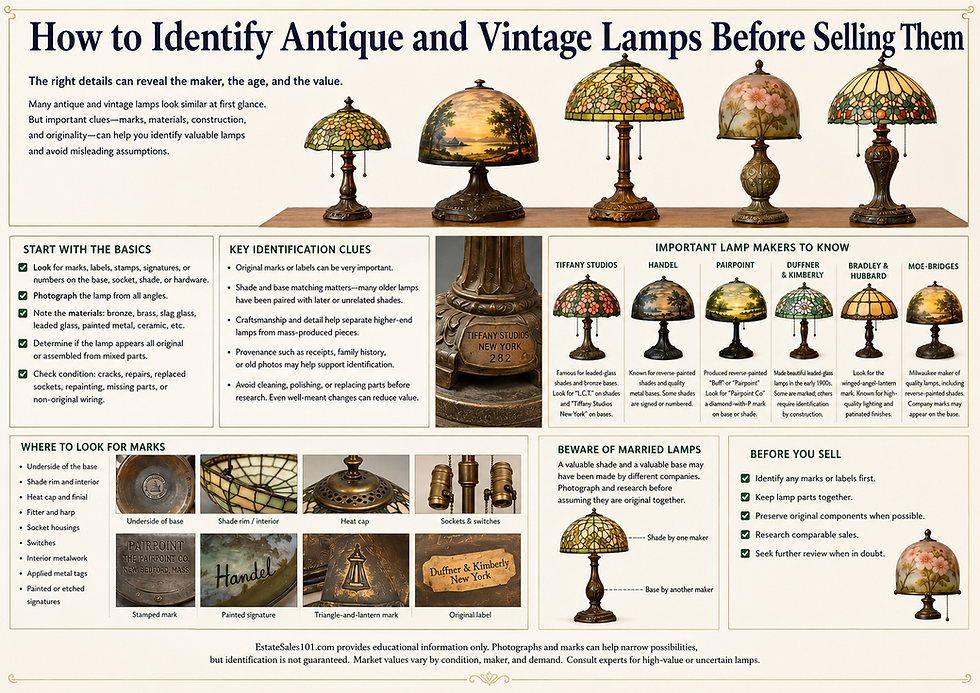
Antique and vintage lamps can be easy to underestimate.
A lamp may have been sitting on the same table for decades, passed down through a family, or stored away because nobody particularly liked it. Yet some older lamps were produced by important American lighting and decorative-arts companies, while others may have valuable glass shades, bronze bases, unusual construction, or identifiable maker marks.
At the same time, appearance can be misleading. A floral leaded-glass shade is not automatically Tiffany. An old-looking reverse-painted shade is not automatically Handel or Pairpoint. And a valuable period shade may have been placed on a base made by an entirely different company.
Before selling an older lamp, it is worth slowing down long enough to identify what you actually have.
Start With the Entire Lamp
Do not begin by looking at only the shade.
Older lamps are often composed of several important parts:
Shade
Base
Heat cap or shade cap
Finial
Sockets
Switches
Harp or fitter
Interior hardware
Wiring
These components may help identify the manufacturer and determine whether the lamp remains in its original configuration.
One of the most important questions is whether the shade and base actually belong together.
Over many decades, shades break, bases get discarded, wiring gets changed, and attractive parts are combined. A lamp can therefore contain authentic old components without being an original factory pairing.
Look Everywhere for Marks
Maker marks are frequently hidden.
Before selling a lamp, photograph and inspect:
The underside of the base
The bottom rim of the shade
Inside the shade
The heat cap
The fitter
Socket housings
Interior metalwork
Small applied metal tags
Painted or etched signatures
Do not aggressively polish the metal or scrub glass in an attempt to reveal a mark. Cleaning can remove evidence, damage finishes, disturb patina, or reduce collector interest.
A mark can be very important, but it should still be treated as evidence rather than automatic proof of authenticity.
Tiffany Studios
Tiffany Studios is perhaps the name homeowners most readily associate with valuable leaded-glass lamps.
That recognition also creates one of the biggest identification problems.
Thousands of later lamps were made in a “Tiffany style,” and other important period manufacturers produced high-quality leaded-glass lamps at the same time.
Documented Tiffany lamps may carry marks such as L.C.T. on shades and TIFFANY STUDIOS / NEW YORK with model or design numbers on bases.
But a mark alone should not end the investigation.
The design of the shade, glass selection, bronze work, construction, model, dimensions, and relationship between the shade and base all matter.
Tiffany Was Not the Only Important Lamp Maker
During the early twentieth century, consumers could choose among numerous American decorative-lighting manufacturers.
Some competed directly with Tiffany.
Important names homeowners may encounter include:
Duffner & Kimberly
Duffner & Kimberly produced high-quality leaded-glass lamps in New York during the early twentieth century.
Some examples were marked, while others may require identification through construction, metalwork, shade design, heat caps, hardware, and comparison with documented examples.
Because the company produced lamps of significant quality, an unsigned leaded-glass lamp should not automatically be dismissed simply because it does not say Tiffany.
Handel
Handel produced several types of collectible decorative lamps and is especially associated with reverse-painted glass shades.
Some Handel shades are signed or numbered, but unsigned examples may sometimes be identified by matching the design or model number to documented factory material.
This illustrates an important lesson: absence of a signature does not necessarily mean absence of identity.
Pairpoint
Pairpoint produced important decorative lamps, including reverse-painted and sculptural “Puffy” shades.
Marks can appear on the base and sometimes the shade. Certain examples use recognizable Pairpoint markings, including a diamond-shaped mark incorporating the letter P.
As with other makers, the shade, base, decoration, construction, and marks should be considered together.
Bradley & Hubbard
Bradley & Hubbard was another significant American manufacturer of decorative lighting and metalwork.
One useful identification clue is the company's recognizable triangle-and-lantern mark.
The company produced high-quality lighting in a variety of forms, so a period lamp should not be judged solely by whether it resembles Tiffany or Handel.
Moe-Bridges
Moe-Bridges of Milwaukee produced decorative lamps, including reverse-painted examples.
Company marks may appear on the base, and documented examples show that Moe-Bridges participated in the same broader decorative-lighting market occupied by better-known companies such as Handel and Pairpoint.
Reverse-Painted Glass Lamps
A reverse-painted shade is decorated from the inside surface of the glass.
Viewed from the outside, the decoration appears beneath the glass surface.
Landscape scenes, flowers, birds, trees, and atmospheric colors are common subjects.
Reverse-painted lamps are frequently associated with companies such as Handel and Pairpoint, but manufacturer attribution should not be made from technique alone.
Look for:
Painted signatures
Model or design numbers
Base marks
Factory labels
Shade shape
Surface texture
Original hardware
Catalog matches
Leaded Glass and Slag Glass Are Not the Same Thing
Homeowners often use terms such as “stained glass,” “slag glass,” and “Tiffany glass” interchangeably.
They describe different things.
A leaded-glass shade is assembled from numerous pieces of glass joined together through metal leading or soldered construction.
A slag-glass lamp typically uses larger panels of colored or marbled glass held within a decorative metal framework.
Both can be collectible.
Neither construction method identifies the manufacturer by itself.
Examine the Base as Carefully as the Shade
The base can contain some of the best identification evidence.
Look at:
Bronze versus brass or other metal
Casting quality
Decorative motifs
Patina
Base shape
Socket arrangement
Switches
Heat-cap construction
Hardware
Screws
Stamped numbers
Maker tags
Some manufacturers used distinctive metalwork or hardware that can help narrow attribution even when the shade is unsigned.
Watch for “Married” Lamps
A married lamp is assembled from parts that did not originally leave the factory together.
This may involve:
An old shade placed on a different old base
A period shade on a modern reproduction base
A replacement finial
Later sockets or hardware
Components made by two different manufacturers
This does not necessarily mean the individual parts have no value.
It does mean the lamp should not automatically be represented as a completely original example of one maker.
Before separating anything, photograph how the lamp is currently assembled.
Condition Matters
Common condition issues include:
Cracked glass
Missing glass segments
Loose leading
Repaired shades
Bent frames
Repainted bases
Polished-away patina
Missing finials
Replacement sockets
Rewired electrical components
Replaced heat caps
Mismatched shade and base
Electrical rewiring is common and may be appropriate for safety, but collectors may still want to know what is original and what has been replaced.
Do not make cosmetic changes simply to make an old lamp look newer before researching it.
Photograph Before You Research
For an unidentified lamp, useful photographs include:
The complete lamp from the front
The complete lamp from the back
The shade from above
The underside of the shade
The shade rim
The heat cap and finial
The entire base
The underside of the base
All sockets and switches
Every mark, stamp, number, label, or signature
Close views of the glass
Close views of metalwork and hardware
Also record the lamp's overall height and the shade diameter.
Those details can make the difference between a vague visual guess and a meaningful identification.
Do Not Start With “What Is It Worth?”
The first question should usually be:
What is it?
Only after the maker, model or type, period, condition, originality, and shade/base relationship are better understood does comparison to actual sales become meaningful.
A sold result for a genuine Tiffany lamp is not a useful comparable for a later Tiffany-style reproduction.
Likewise, a documented Handel shade on its correct original base may not be directly comparable to a similar shade mounted on an unrelated base.
Identification comes before valuation.
When an Older Lamp Deserves More Research
Consider setting a lamp aside for closer review when you find:
An identifiable maker mark
An unusual bronze base
High-quality leaded glass
Reverse-painted decoration
A documented model or design number
A Tiffany Studios, Handel, Pairpoint, Duffner & Kimberly, Bradley & Hubbard, or other significant maker clue
Unusual construction
Strong family provenance
Original paperwork or photographs
A shade and base that appear unusually well matched in design and age
An unfamiliar lamp should not automatically be assumed valuable.
But it also should not be sold casually simply because nobody recognizes the name.
Ask Deeper Questions
Lamp identification often becomes much easier once you know what details matter.
EstateSales101.com can help homeowners and families work through questions about maker marks, shade construction, reverse-painted glass, leaded glass, slag glass, Tiffany-style lamps, Handel, Pairpoint, Duffner & Kimberly, Bradley & Hubbard, and other vintage lighting.
If you have an unidentified lamp, begin with clear photographs of the entire lamp, shade, base, underside, hardware, and every visible mark.
The goal is not to force an attribution from one clue.
It is to gather enough evidence to know what deserves deeper research before the lamp is sold.
EstateSales101.com provides educational information only. Photographs and marks can help narrow possibilities, but important lamps may require hands-on evaluation by a qualified decorative-arts or lighting specialist.


Comments